Repetitive operational work handled by systems, with people in control.
Most businesses run on routines: orders to confirm, enquiries to answer, approvals to chase, reports to compile. BWOK maps those routines and builds the workflows that run them, so people do the work that needs judgement and the system does the rest.
- Starting point
- How the work happens today, step by step
- Outcome
- Routines that run themselves, with clear hand-offs to people
- Typical first increment
- One workflow, automated end to end, in use within weeks
The routines we automate.
Each tile is a part of an operation that usually runs on manual effort today. Each becomes a workflow with data, rules and clear hand-offs.
- 01
Process mapping & digitisation
The current workflow made explicit, measured and ready to automate.
- Workflow assessment
- Bottleneck analysis
- Operating procedures as systems
- Roles and hand-offs
- 02
Order & fulfilment workflows
Orders captured, confirmed, fulfilled and communicated without re-entering anything by hand.
- Order capture
- Status updates
- Fulfilment hand-offs
- Stock movements
- 03
Customer workflows
Enquiries, quotes, bookings and follow-ups that never fall through the gaps.
- Enquiry routing
- Quotes and bookings
- Follow-up sequences
- Support workflows
- 04
Administrative automation
The routine behind the business handled by systems.
- Document generation
- Scheduling
- Reminders and notifications
- Record keeping
- 05
Approvals & hand-offs
Decisions routed to the right person, with everything they need to decide.
- Approval flows
- Escalations
- Audit trails
- Notifications
- 06
Operational reporting
Operational and financial views produced from the data the systems already hold.
- Operational dashboards
- Scheduled reports
- Exceptions and alerts
Logic, automation and operations.
Process automation lives in the rules that connect a business's data to the people who act on it: the logic layer, the automations that run on schedules and events, and the operational views that show what happened.
Conceptual diagram of a business system. Lit parts are the ones this solution concerns.
- Customer
- Website
- Application
- Business logic
- Database
- AI
- Automation
- Analytics
- Operations
One process, from workflow to working system.
The same six steps run every engagement, whatever the industry or the system being built. Each step has a purpose, a set of activities and a concrete outcome before the next begins.
- 01
Understand
The business, its people and the problem, as they are.
- 02
Map
The current process, step by step.
- 03
Design
The system, designed around the actual business.
- 04
Build
Software, automation and integrations, in increments.
- 05
Deploy
Into the real operating environment.
- 06
Improve
Usage and results decide what changes next.
Systems BWOK builds and operates.
Not demos. The product, the education platform and the corporate platform are deployed, in use and maintained by the same team that builds for clients.
All products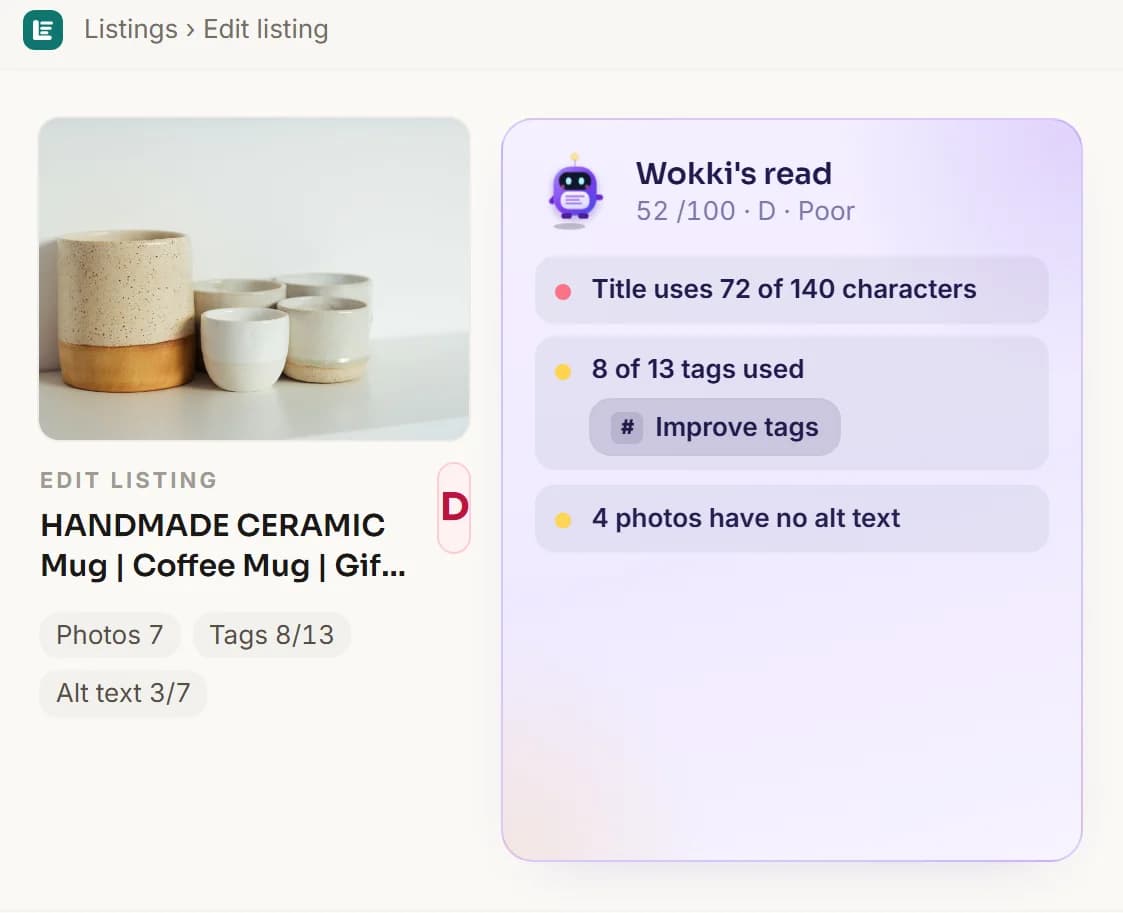 01ProductLive product
Listawok
BWOK's live listing manager for Etsy sellers. Wokki reads every listing, ranks what holds it back and writes the fix on request.
- Built by BWOK
- listawok.com
- Free plan
 02Education platformOperating
BWOK Institute
The Institute's own site and learning portal: courses, enrolment, live and recorded classes, attendance and notices.
- bskills.bwok.world
- BWOK LMS
- Onsite · online · recorded
- 03Corporate platformOperating
bwok.world platform
This site and its control center: content, leads, the business showcase and settings managed in one console, deployed on BWOK's own server.
- Next.js
- Supabase
- Self-hosted
Automate the routines.
Tell us which part of the operation takes the most manual effort. We will map it and propose the first workflow to automate.